
“Why Simple Stories Aren’t Really Simple”
When handed a novel or short story to read, students are quick to make decisions about the characters. She’s the hero. He’s the villain. One character is a jerk. Another gets angry, so they must have anger issues. End of story. It’s a clean way of seeing things, and for a while, it works.
They do the same thing in real life (most of us do), so that’s what they’re bringing to the story. It’s just easier that way. But fiction gives us a place to slow that down a little, to see how quickly our judgments start to break apart, and how much more complicated—and more interesting—things usually are once you get close enough to someone on an emotional plane to start looking inside them.
In my YA novel The Reel Life of Zara Kegg, Zara lives in that same space for most of the book. The big line in the sand for her—there are people who tell the truth, and people who don’t. For the ones who don’t (including her mother’s doctors and nurses and, for a time, her father and boyfriend), you keep your distance. They are liars, so you don’t let them in. And that’s not just a rule, but a way of holding things together when everything around you is falling apart.
During all of this, she’s doing her job in the projection booth at the Palace Theater, showing old black-and-white movies—B movies, ’50s and ’60s sci-fi and horror. The kind with low budgets, bad rubber masks, and worse dialogue. In almost every cheap film of that era, a UFO falls out of the sky or a hidden monster crawls up from the swamp, and everyone—the military, the local science teacher, a few kids from the high school—spends the rest of the movie trying to figure out what it is and how to stop it. On the surface, these stories seem simple. A threat shows up, but in the end, it’s handled and order is restored.
But those movies were never so simple, never really just about the monster. Not exactly. They expressed Cold War fears of invasion, of annihilation, of something coming from above that you couldn’t defend against. In the movies, it’s a creature or a spaceship. In real life, at that time, it was nuclear weapons or foreign invaders. The movies gave those fears a shape, and, for a while at least, a way to contain them and make them manageable.
Watching them over and over, Zara starts to see that the lines we draw in real life aren’t as clear as she thought. There’s a movie she shows one night, The Hideous Sun Demon, where a scientist exposed to radiation turns into a monster, kills a few people, and terrorizes a lot more. On the surface, he’s exactly what you’d expect—a threat, something that has to be stopped. But as the movie goes on, that begins to shift. None of it was really his fault, and he spends most of the film trying to manage what’s happening to him by staying out of the sun, staying away from other people, doing what he can not to hurt anyone. By the end, Zara finds herself crying in an empty theater, because all he really wanted was to live his life in the dark, to be left alone.
It’s not hard to see why that resonates with her. She’s up in that booth most nights, by herself, working in the dark and trying to hold her life together in the wake of her mother’s death. The monster isn’t just a monster anymore, and the lines she’s been drawing—about who people are, what they’ve done, what that means—don’t hold in quite the same way.
I see other versions of that in the classroom. Students read a story or novel and want to put the entire work inside boxes with labels—who’s right, who’s wrong, what the story is “about.” And I get it. Our brains crave that kind of black-or-white thinking. But that’s also where much of the life of the story gets flattened. As teachers we start looking for theme, or symbols, our own labels, so we can name them and move on, instead of staying with the character long enough to understand what’s actually going on with them, what motivates that person, what their interior life is like.
What tends to matter more is slowing that down. Not asking what the story means, exactly, but what this person is doing, what they’re feeling, why it doesn’t always line up. That kind of attention—trying to understand before you label—goes a long way, not just with literature, but with people. It’s more interesting to stay with the character a little longer. To get students to ask what they’re doing, what they’re not saying, what doesn’t quite add up. Not to excuse it, necessarily, but to understand it. That shift—from labeling to paying attention—changes the conversation along with our own understanding. It changes how we read and how deeply the right book can resonate. It also changes how we read and understand people, even those we are quick to label. And that’s a life skill that will stay with us always, making our lives that much deeper and richer.
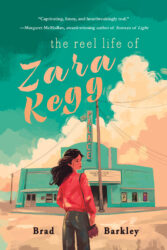
The Reel Life of Zara Kegg
Author: Brad Barkley
Published June 16th, 2026 by Regal House
About the Book: 16-year-old Zara still feels like an outsider in Carolina Beach. Working during the beach’s off-season as the lone projectionist at the Palace—a rundown retro cinema that shows only vintage ’50s sci-fi and horror flicks, including a major Godzilla marathon—she spends her nights in a dusty booth, fueled by coffee, pushups, and the occasional existential crisis. Then she meets Zachary, who might be the most interesting person she’s ever met. As their friendship deepens into something more, Zara learns about the struggles Zachary hides beneath his charm and wonders if trust is possible.

About the Author: Brad Barkley is the author of the novels “Money, Love” and “Alison’s Automotive Repair Manual,” named as Best Books of the Year by The Washington Post and Library Journal. He has published two story collections, and his short work has appeared in 40+ magazines including The Southern Review, The Georgia Review, Oxford American, and Virginia Quarterly Review, which twice awarded him the Emily Clark Balch Prize for Fiction. He’s also the co-author of three YA novels — Scrambled Eggs at Midnight, Dream Factory, and Jars of Glass — recognized by the American Library Association and the New York State Reading Association. Before becoming Professor of Creative Writing, he worked a string of odd jobs—from short-order cook and roofer to telemarketer, dairy bottling line worker, and even hang-gliding instructor—work that keeps his fiction grounded in real places and people. He has received multiple Maryland State Arts Council awards and a Creative Writing Fellowship from the National Endowment for the Arts. Find out more about him at www.bradbarkley.com.
Thank you, Brad, for this reminder that there is more to stories than what is first seen!

1 thought on “Author Guest Post: “Why Simple Stories Aren’t Really Simple” by Brad Barkley, Author of The Reel Life of Zara Kegg”