
“Busting STEM Stereotypes in the Elementary Classroom”
It’s hard to believe that stereotypes about what constitutes appropriate ‘girl’ behavior still exist. After all, this is 2026, right? Women vote, travel in space, dig for dinosaur bones, and work in Silicon Valley. Nobody tells girls or women what they can or cannot be, and woe to the person who tries!
But…when we picture a ‘scientist’, the first image to come to mind is not of a glamorous, dark-haired, gown-wearing, beauty (I see you, Hedy Lamarr). Or even of a studious, lab-coat donning one (calling you out, Alma Levant Hayden). Instead, the picture in your, and in your students’, head, is likely the image of a man (we do appreciate you, Albert Einstein).
And so, even when no one tells children explicitly which careers they should choose, these stereotypes still impact behavior, expectations, and life choices. How can a girl become a scientist if she doesn’t think to imagine herself as one?
As a girl scientist myself, an educator, and the mother of a girl, I’ve seen how these stereotypes can prevent women from even considering the careers, and other, opportunities open to them. I wrote my picture book What Kind of Scientist Can a Girl Be? to help break these stereotypes and reinforce that of course a girl- just like a boy- can be any kind of scientist, because science is for everyone.
The elementary classroom is a good place to push against these implicit beliefs. Here are a few ways to use my book to challenge – and change- STEM stereotypes. I hope you find them useful!
- Draw a Scientist, Twice
Hand out blank paper and ask every student to draw a scientist. Collect the drawings and set them aside. Then read together. Afterward, ask the students to draw a scientist again, and then put the before-and-after drawings side by side. The pictures usually speak for themselves. The first round is almost always the same figure: older man, wild hair, white coat, alone in a lab. The second round looks different- with some kids drawing themselves!
- What Kind of Scientist Can I Be?
Flip the question onto them. Each child picks a kind of scientist they’d like to be and draws or writes about themselves doing that science, in their own clothes, in their own neighborhood. A marine biologist at the local creek. An astronomer peering at the sky from their bedroom window. A psychologist studying why the class hamster only runs at night. Science isn’t a costume you have to fit into; its everywhere, for everyone.
- Every Kind of Question
Have each student write down one question they want answered. Why is the sky blue? Do dogs dream? What makes bread rise? Then together match each question to a kind of scientist who investigates it. The physicist, the biologist, the chemist. They discover two things at once: that their own curiosity already looks exactly like a scientist, and that there’s a kind of science for every kind of wondering. You can even tape the questions to a “Wall of Scientists” and leave it up all year. Every time a student asks a great question in class, add it!
My hope is that girls, and boys, understand that science, and scientific thinking, is expressly, optimistically, fascinatingly open to everyone. And maybe, someday, the first image that fills our mind when we are asked to think of a scientist, is of ourselves.
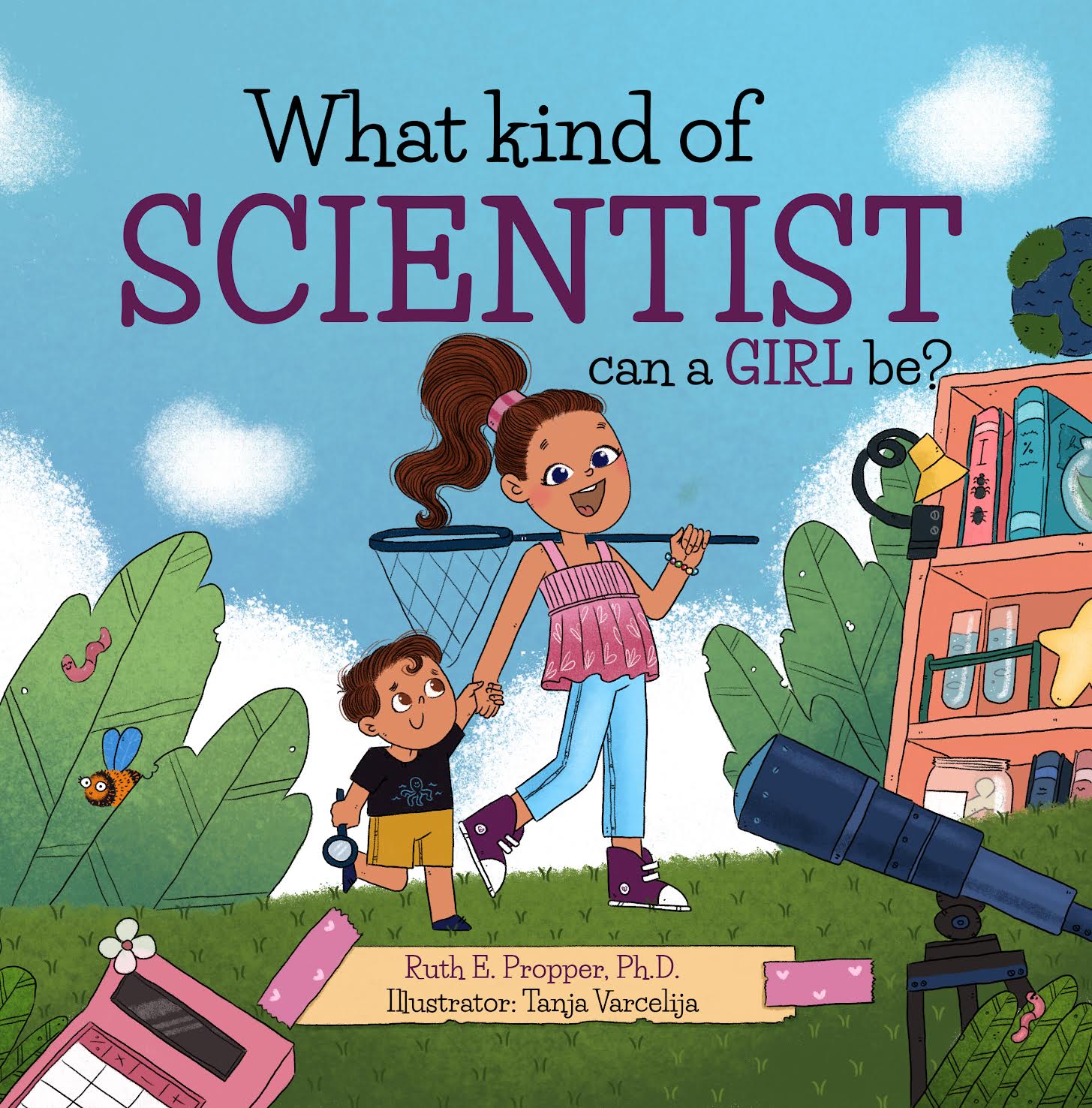
What Kind of Scientist can a Girl be?
Author: Ruth E. Propper, PhD.
Illustrator: Tanja Varcelija
Published January 29th, 2023
About the Book: As a squabbling sister and brother play pretend, they bicker about what girls can’t, and can, do. Botanist, geneticist, mathematician, paleontologist… Will they ever agree? What Kind of Scientist Can a Girl Be? teaches that yes, a girl can be any kind of scientist, with a glossary of kinds of scientists, what they study, and the names and accomplishments of real women in science. A sequel, What Kind of Girl Can a Scientist Be?, with the same characters, is currently in production and will be out by early 2027.
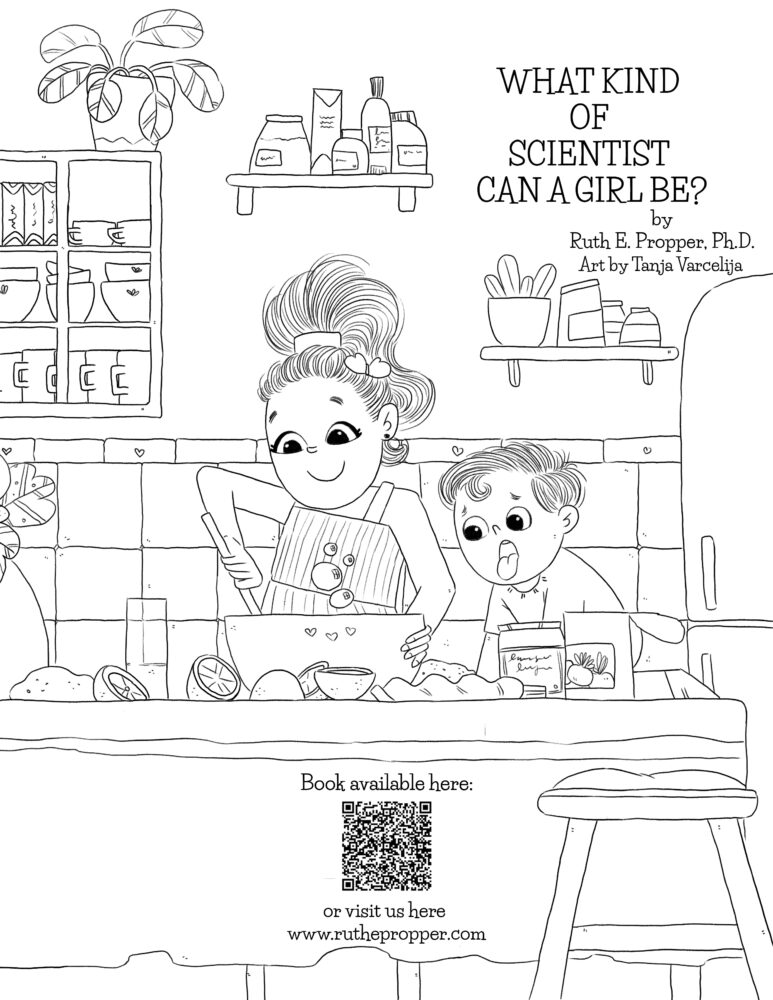
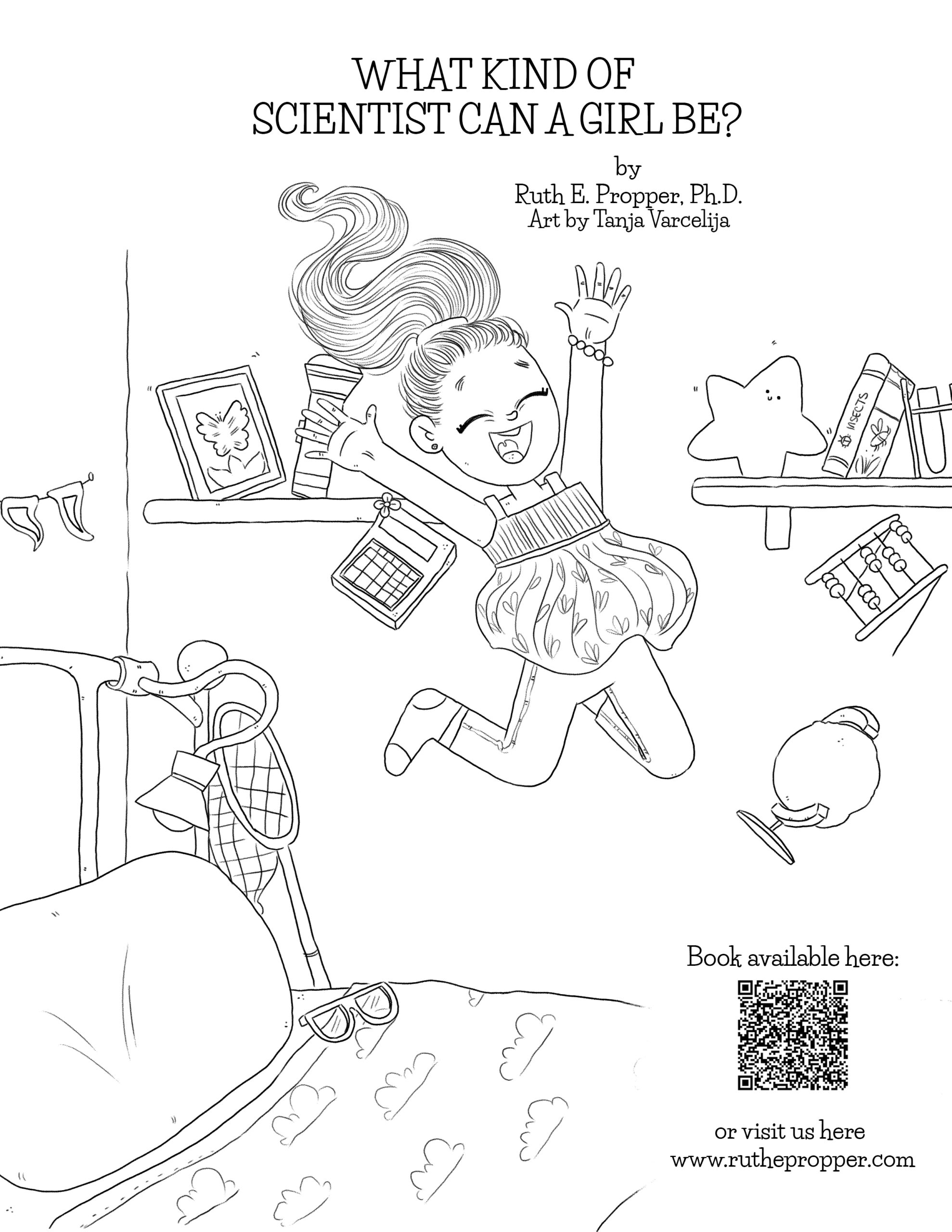
- Here are two free coloring sheets!
About the Author: Ruth E. Propper, Ph.D., is a scientist, who also happens to be a girl. She holds a Ph.D. in Psychology, with a focus on cognitive neuroscience, from the University of Toledo. She completed her Postdoctoral work at Massachusetts Mental Health Research Center, Harvard Medical School, in Boston. She is a full professor in the Psychology Department at Montclair State University, New Jersey, where she is the Director of the Cerebral Lateralization Laboratory and of the MSU-Kessler Internship, where she places undergraduate and graduate students in real working neuroscience laboratories, so that they too can become science kids. She is passionate about the scientific method and girls in science, and is the author of three children’s books, including What Kind of Scientist Can a Girl Be? and the Lizzie Loftus mystery series. www.ruthepropper.com
Thank you, Dr. Propper, for this focus on girls and STEM!
