
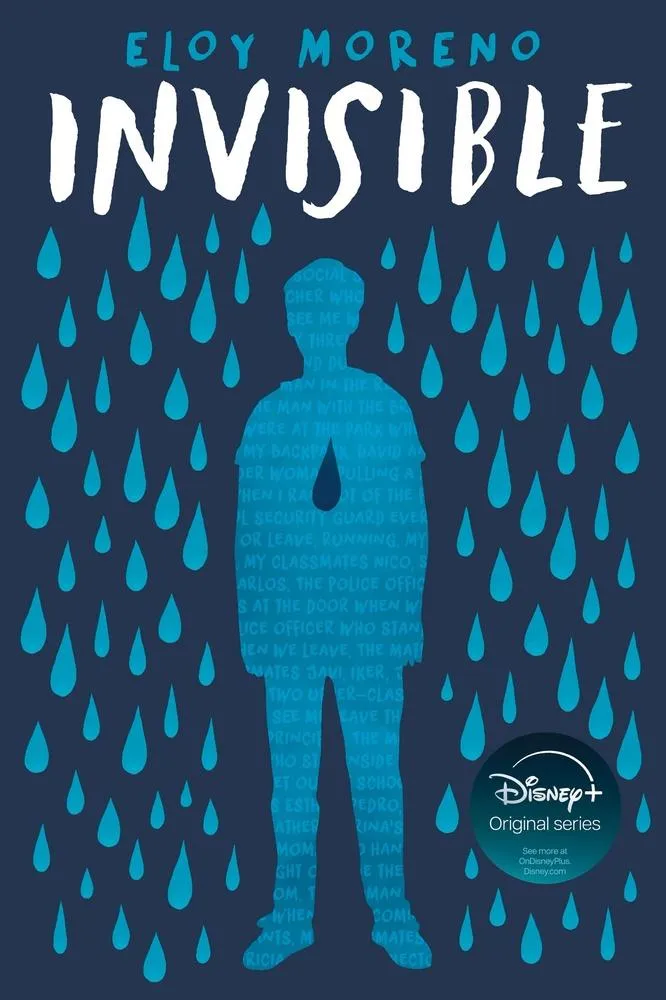
Invisible
Author: Eloy Moreno
Published August 4th, 2026 by Sourcebooks Young Readers
Originally published February 1st, 2018 in Spanish
About the Book: When a thirteen-year-old boy is bullied at school, he discovers an ability to turn “invisible.” An emotional and compelling portrayal of bullying and mental health, perfect for fans of RJ Palacio’s Wonder.
“…I decided to find a new power, one so great they wouldn’t be able to hurt me at all. And I finally found it.”
“Which power was that?”
“I have the power to make myself invisible.”
A boy wakes up in a hospital room with no memory of how he got there.
As time passes, the pieces of what happened that fateful day start falling into place, and the boy remembers his secret: he has the power to become invisible.
But the boy is hesitant to tell anyone the truth. What will they think of him if they find out the reason he gained this ability? And what if it makes everything worse?
Told in alternating perspectives following the boy, his friends, his parents, his teacher, as well as his bully, the events of that day are slowly revealed through flashbacks. A heart wrenching and powerful read for anyone who has ever felt “invisible.”
We are excited to be able to interview Eloy Moreno about his newest book, Invisible, about a bullied thirteen year-old boy, specifically during National Bullying Prevention Month.
Q: Where did the idea for this book come from?
A: The idea for the book came from a real-life experience of a friend of mine. One day, while we were talking about bullying, my friend tearfully confessed that she had suffered severe bullying for two years as a child and had never told anyone, not even her parents. I was the first person she was telling, and it had been 25 years since then. That’s when I realized that bullying isn’t just a childhood thing; it’s something you carry with you into adulthood.
Q: Many students feel unseen in school spaces. What do you hope educators understand about those students after reading this book?
A: One of the main objectives of this work is to make us all—educators, adults, parents—realize that bullying is often not visible at first glance; we must be vigilant.
And above all, it teaches us not to look the other way.
Q: How did you approach writing characters whose experiences may mirror those of marginalized or overlooked students? What responsibilities did you feel in portraying those identities authentically?
A: It was one of the most complicated things, because I had to get inside the minds of 12-13 year old boys and girls. It’s true that I spoke with many child psychologists who told me about numerous cases of bullying they had dealt with. It’s also true that you feel a great responsibility, because you know that the book is going to be read by teenagers, and especially by teenagers who have suffered some kind of bullying.
Q: For students who see themselves in this story, what do you hope they feel? And for students who don’t share these experiences, what do you hope they learn?
A: For those who see themselves reflected in this book, I hope they realize they’re not alone in feeling this way, and above all, I hope that thanks to it, talking about bullying will no longer be taboo. And for those who haven’t experienced it but have witnessed it, I encourage you to speak up, report it, and get involved when you see someone being bullied. The worst thing is for us to just be bystanders.
Q: What conversations do you hope this book sparks in classrooms and libraries? Are there particular themes—empathy, bias, belonging, community—you hope educators highlight?
A: The best part is that I get feedback on how the book is being used in classrooms. Many students and teachers tell me that the novel has sparked discussions about the topic in class. There have even been cases of bullying in the classroom that have been detected thanks to the book. And in that respect, it’s a valuable tool for educators to use when talking about the issue.
Q: How can librarians and teachers use Invisible to support social‑emotional learning or build inclusive reading communities?
A: I think it’s a tool that allows you to talk openly about a topic like bullying, that allows you to put yourself in the shoes of the aggressor, the victim, and the witnesses. It’s like having a mirror in front of you.
Q: If educators wanted to pair this book with other texts, topics, or activities, what would you recommend?
A: In this case, I could combine the book with the Disney+ series of the same title, so that they could see the differences and similarities between the film adaptation and the book.
Q: What advice would you give educators who want to make their classrooms and libraries places where no student feels invisible?
A: Above all, they need to talk about it; it shouldn’t be taboo. It’s necessary to acknowledge that this problem exists and discuss it openly, and especially to communicate that it can be solved—in fact, in most cases it is.
Q: What do you hope stays with young readers long after they finish the book? And what do you hope stays with the adults who teach and support them?
A: I hope that both young people and adults, when they finish the book, will think about never looking the other way, because witnesses are also the ones who can stop the problem. We must not look the other way.
About the Author: Eloy Moreno is the author of several novels, including Invisible, which has reached over 30 countries and has been translated into more than 20 languages. It even has its own global series on Disney+.
Thank you, Eloy, for sharing your novel and its powerful story with us!
