

Sofia is a 13-year-old brilliant reader who aspires to be a book reviewer. Since she was 8 years old, on select weeks, Sofia shares her favorite books with other young people her age! She is one of the most well-read youth that we know, so she is highly qualified for this role!
Dear readers,
Hi and welcome to another book review, except this time, I will be recommending an author, and reviewing some of her books! Let me introduce you to Ruta Sepetys, an amazing YA historical fiction author whose books are sure to captivate any reader! She has won the Carnegie Medal for Writing, which is a prestigious award only given to one author per year. While reading her books, I have noticed a common theme of her focusing on lesser known parts of history, for example Romanian communism in the late 80’s, or enigma codebreakers during WWII. I find it fascinating to learn about these important parts of history that I would have otherwise overlooked, and having the main characters be children my age makes her books more relatable and engaging. The way Sepetys sheds light on forgotten pieces of the past is captivating and it is why I am recommending her work to you. In this review, I will share my thoughts on a few of her books, including I Must Betray You, The Fountains of Silence, Salt to the Sea and Between Shades of Gray. I have also already reviewed another amazing book by her, called The Bletchley Riddle (review linked in title), which is an enthralling tale about two kids uncovering the secrets of a code-breaking hub in England during WWII.
If you are looking for a similar type of author but for slightly younger kids, I would highly recommend Jennifer A. Nielsen, who is a historical fiction author that I loved as a kid (around 8-12 years old)! I would specifically recommend Words on Fire, which is about a Lithuanian girl who joins an undercover ring of book smugglers during the Russian-Lithuanian revolution to try and keep her country’s history preserved. I also loved A Night Divided, a story about a girl escaping East Germany during WWII, and the struggles that came along with that!
I Must Betray You
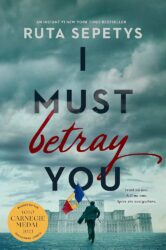
I Must Betray You is a powerful book that will keep you on the edge of your seat! The main character is a boy named Cristian who is living in communist Romania (1989). You follow Cristian as you learn all about the horrible quality of living and the ways that the “dictator,” Ceaușescu, controlled Romanians. As you read the book, you will realize how Romanians were never truly alone, even in their own homes as there were listening devices installed to keep them in check. Romanians couldn’t trust anybody, because it was very common for civilians to be informers for the Securitate, Ceaușescu’s spy organization, tasked with keeping tabs on citizens and punishing them if they are doing anything illegal. In the Author’s Note of I Must Betray You, Sepetys even says “it’s estimated that one in every ten citizens provided information” (Sepetys 307). It was heartbreaking to see how people were always suspicious of one another, and couldn’t really form true friendships or talk about their problems, which came from the fear of being in serious trouble, or even getting killed because they said the wrong thing.
In this tale of survival, you experience the world through Cristian’s eyes, how he must bribe people with Kent cigarettes to pay for medicine or even get anesthesia at the dentist, stand in line for hours in the cold to get measly rations, and live in a literal closet. When he gets caught with an American Dollar, which is highly illegal, he is blackmailed and forced to turn on the people he loves. He becomes an informer for the Securitate, and his mission is to spy on an American diplomatic family. He must keep his job a secret or else his family would kill him, as they hate the Romanian government and try to keep to themselves. The only problem is that if his family or friends find out he has betrayed them, it would destroy whatever relationships he had, while breaking him in the process…
If you enjoy I Must Betray You, I would highly recommend reading The Lost Year (review linked in title) by Katherine Marsh, which talks about the Ukrainian Holodomor and how kids view the hardship in their country. While reading I Must Betray You, I often found myself thinking back to The Lost Year and how these two different events had similar effects on children.
The Fountains of Silence
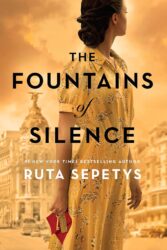
The Fountains of Silence is a shocking story told in many perspectives, showing a new lens on Franco’s dictatorship in Spain. I loved the many angles this novel was told from since it allowed me to get a deeper understanding of life in late 50’s Madrid. The perspectives range from a wealthy oil-investor’s son, a poor anti-Franco hotel servant, to a devoted orphanage worker, but they were all told from the youth’s eyes. The differences in each of the views lets the reader get a fuller picture of what life in Spain was like. The only downside to the many perspectives is that it makes the story quite complicated to follow, especially since each new chapter did not explicitly say whose perspective it was written in. For the first quarter of the book I was just trying to understand who Sepetys was talking about and if you can’t handle more convoluted stories, I would recommend sitting this one out. Other than that though, I loved the constant cloud of secrets that followed the characters around, because I was always trying to uncover them. You can really tell how much research Sepetys has done, as each of the people have their own way of coping with Franco’s dictatorship, some deciding to stay silent while others showing their rebellion.
Daniel, the wealthy oil-investor’s son who is visiting Madrid, is curious and empathetic, wanting to understand and help the Spanish people, especially when he meets Ana, who works at the hotel he is staying at, the Castellana Hilton. Ana is a rule follower who doesn’t dare step out of line, in fear of losing her job at the prestigious hotel she works at. Her sister Julia has always told her, we are prettier with our mouths shut, but when Daniel takes an interest in her and visits her house in Vallecas, she slowly warms up to him and provides insight into her life in Spain.
Their affection for each other grows but they must keep it a secret from the Guardia Civil, Franco’s violent military, or Ana risks getting fired or even killed. While this is happening, Ana’s cousin Puri, who is a “good Spaniard” and orphanage worker discovers things she shouldn’t have while peeking through the adoption files of her workplace. Ana’s brother Rafa talks about his work at the city slaughterhouse, where many young men like him work, even though there is a lot of blood. All of these perspectives are artfully woven together to create a tale of immense depth and importance.
Salt to the Sea
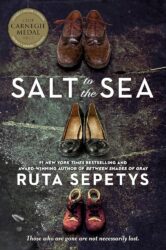
Salt to the Sea is a heartbreaking story that follows regular people trying to flee East Prussia during WWII. You see the dangers of trying to escape from the Red Army, also known as the Soviet Army, while also not being able to be seen by German soldiers because official evacuation orders had not been given yet. People of all ages had to make the decision; try to make a run for Germany, through the freezing winter, a journey which would take many lives, or stay in their house and face certain death from the Soviets. People often traveled in groups so they could help each other, and that is exactly how we are introduced to our characters. The story is told from four different perspectives, three of the characters are fleeing and cross paths along the way, while the other is a devout Nazi officer, who is stationed on a ship that will take refugees to safety. Each of the characters have their own unique quirks and secrets! There is Joana, who is a legal refugee in East Prussia (originally from Lithuania) and is in her twenties. She is educated as a nurse and occasionally has flashbacks to her past. She meets paths with Florian and Emilia, both also fleeing towards safety. Florian is a Prussian soldier, who is very secretive and untrustworthy. Emilia is a Polish illegal refugee, whose past is shrouded in mystery.
Everybody who is running away from the Red Army has one destination, a ship that will take them into Germany, and therefore into safety. During their journeys, Albert is on the Wilhelm Gustloff, preparing the ship for its voyage that will take over 8,000 fleeing Germans to safety. We first experience his delusional personality through letters he sends his lover, Hannelore, but later we actually see his actions. At the end, these stories merge to tell the story of the Wilhelm Gustloff, the deadliest maritime tragedy in history. Yes, it was much deadlier than the Titanic or Lusitania, the only difference is that the Gustloff was full of refugees, causing it to get buried in the history books. Salt to the Sea really kept me on the edge of my seat, while also bringing me to tears at some parts. It is a beautiful book that rips the veil off of this important, but often forgotten piece of history.
Between Shades of Gray
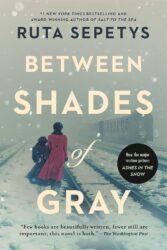
Between Shades of Gray tells the story of a Lithuanian family that was taken from their home and forced on a long journey of loss and fear by the Soviet Union. 16 year old Lina is squished in a train car with her mom, younger brother, and countless other innocent deportees. They aren’t told where they are going, or how long they will be with these people for. The NKVD, which is a type of Soviet police, kill anyone who dares to step out of their assigned train car, instilling fear in everybody. On the train, people get measly rations that barely keep them alive, causing many to be malnourished and get sick. Lina describes the car smelling of urine and sweat, very uncomfortable, especially since they were in it for a long time. It is told solely from 16 year old Lina’s perspective, as she copes with the uncertainty and fear of being abducted from home and taken from her father.
The train ride seemingly lasts forever, and the people are treated like trash, having to use the restroom in a hole in the floor, and being spat on and cursed at by the NKVD officers. To try to find an escape from her horrible life, Lina distracts herself with her art. Even at home, she was an excellent artist, but now she wants to document her journey for her father so that he can find her. She doesn’t know exactly where her father is, other than that he is also on a train away from Lithuania. When the train finally stops and people are ordered out, everybody is relieved, until they find that they are in a secluded town in Siberia where temperatures frequently drop below zero in the winter. People are crammed into already occupied huts, where the people who already live in them sure aren’t happy to share. They soon find out that they are in a kolkhoz, which is a community farm, meaning that whatever crops they grow go to the NKVD officers, or are shipped away for other people to enjoy. They still have to try to survive off of puny rations while working sunrise to sunset, digging up beets or other types of hard manual labor. Between Shades of Gray tells the heartbreaking story of how the NKVD stripped people of their dignity and basic human rights during WWII. Sepetys never fails to blow me away with the way she portrays history and hardship and this book was no different! I loved how Lina’s young perspective meant that she wasn’t afraid to ask questions and be curious, which helped me better understand this crazy point in history.
Thank you for reading this review, I love all of these books and I hope you enjoy them as well!

**Thanks so much, Sofia!**
1 thought on “Sofia’s YA Book Nook: Author Recommendation! Ruta Sepetys”